

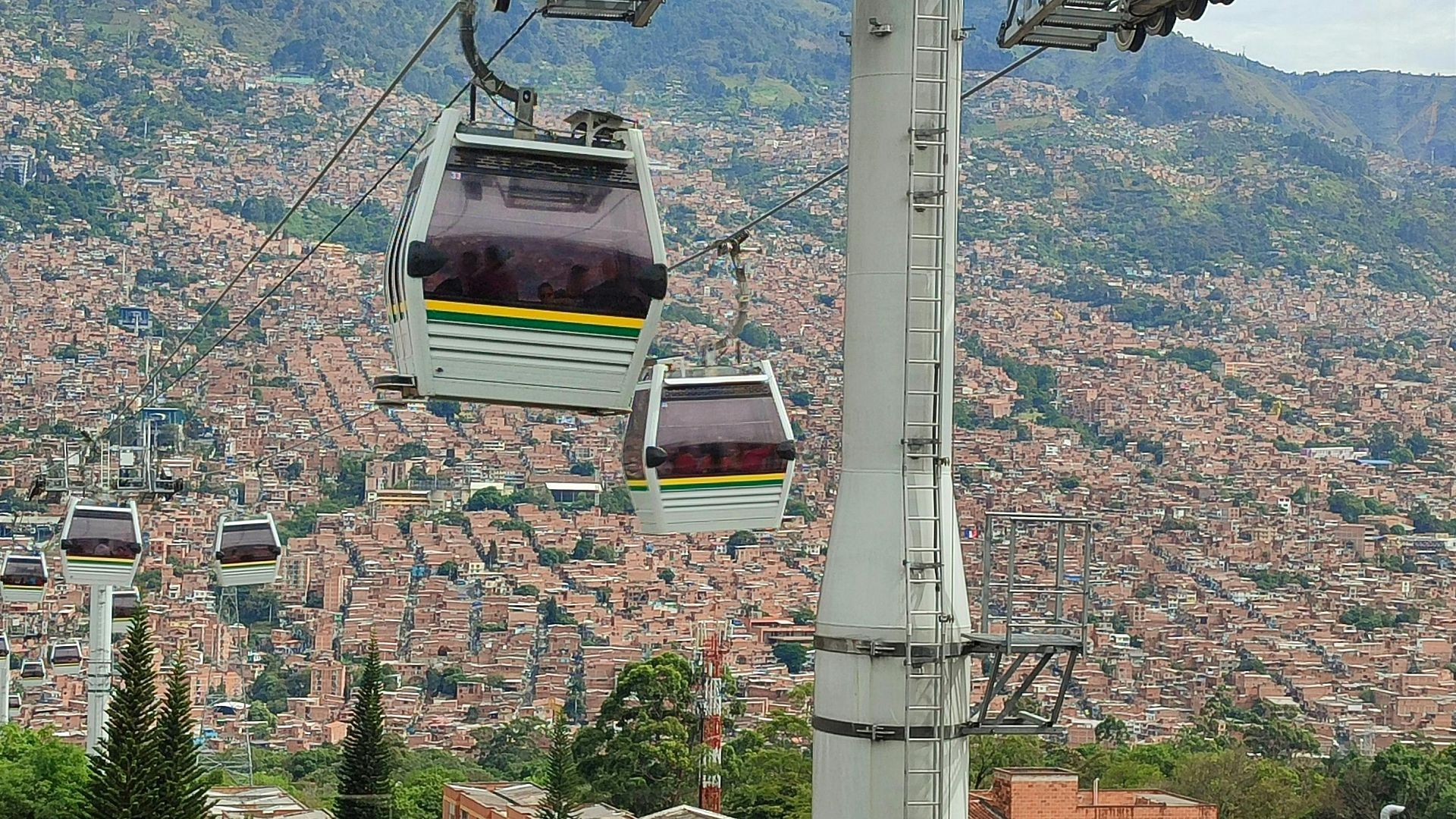
When people talk about cable cars around the world, they usually think of snow, skiing, and luxury tourism. Medellín turned that concept on its head. Here, the cabins that fly over the mountain are not for skiers, but for grandmothers, students, and workers who used to spend hours traveling from their neighborhoods to the city center.
The Metrocable is the pride of the paisas. Inaugurated in 2004, it was the first aerial cable system in the world dedicated to mass passenger transport and integrated into a Metro network. For tourists, it represents a unique opportunity to “fly” over the city for less than a dollar (on the integrated lines), obtaining a raw, real, and fascinating aerial perspective of the urban density.
It's not just a nice ride; it's a lesson in sociology and urban planning from the air. If you want to understand how Medellín is built, you have to get on. Here are the lines you can't miss.
Line K: La Pionera (Acevedo - Santo Domingo)
This was the first line and remains the most iconic.
● The Route: It departs from Acevedo station (in the north) and climbs up to the Santo Domingo Savio neighborhood. You literally fly over the rooftops, seeing everyday life in Communes 1 and 2: people hanging clothes on rooftops, children playing soccer on makeshift fields, and colorful facades.
● The Destination: When you reach the last station, Santo Domingo, you can get off and see the life of a neighborhood that has gone from being a red-light district to a tourist viewpoint.
● Cost: It is integrated into the Metro system. If you don't leave the station, you don't pay extra.
Line L: Escape to the forest (Santo Domingo - Arví)
This is the continuation of Line K and is exclusively for tourists.
● The Change: At Santo Domingo station, you transfer to Line L. Here, the landscape changes dramatically. You leave behind the brick and concrete and, in a matter of seconds, you are flying over the treetops of a huge forest reserve. The silence is absolute.
● Destination: You arrive at Arví Park, a farmers' market and ecological hiking area.
● Cost: This line has an additional cost (approx. 13,000 - 15,000 COP for tourists, subject to annual changes). It is paid for with the same Civic Card.
● Check the schedule: Line L does NOT operate on Mondays (or Tuesdays if Monday is a holiday) due to maintenance. Plan your visit from Tuesday to Sunday.
Line J: The view of the west (San Javier - La Aurora)
If you are going to take the Comuna 13 tour, you will already be at San Javier station. Take advantage of this cable car.
● The View: Climb up the western slope. It's impressive because you pass over neighborhoods that were once the scene of military operations and are now full of life. The slope is steep and offers a view of the city center from the other side of the valley.
● Tip: It's ideal for watching the sunset over the city.
Line P: The modern line (Acevedo - El Picacho)
This is the newest line (opened in 2021) and the one with the highest capacity and speed.
● The “Wow” Factor: It climbs Cerro El Picacho, where the Cristo Rey (a giant statue) is located. The views from here are, for many, superior to those from the other lines because you are at a higher and more central point in the north.
● The Experience: The cabins are larger and the ride is very smooth. At the top, there are spectacular viewing points.
Practical guide for tourists
1. The Civic Card: To enter the Metro and Metrocable system, you need a Civic Card. You can buy the “Eventual” version at the ticket offices of any station. We recommend recharging enough balance for a round trip.
2. Fare Integration: With a single ticket (approx. 3,500 COP), you can take the Metro in El Poblado, get off at Acevedo, and board the Metrocable Line K, P, or J without paying again, as long as you do not exit the turnstiles. The only exception is Line L (Arví).
3. Security: Security is excellent within the Metro system and cabins (“Metro Culture”). However, when getting off at stations in the upper neighborhoods (Santo Domingo, La Aurora), stay in the main commercial and tourist areas. Avoid entering lonely alleys unless you are with a local guide.
4. Hours: The system operates from 4:30 a.m. to 11:00 p.m. (varies on Sundays and holidays). Avoid rush hour (6:00 a.m. to 8:00 a.m. and 5:00 p.m. to 7:00 p.m.) when locals use it to get to work; it will be very crowded. The best time is mid-morning (10:00 a.m.).
Connection to your stay at Sloh
Staying in the Manila neighborhood gives you a huge logistical advantage.
● The Poblado Metro station is just a few minutes' walk from Hotel Sloh.
● From there, you are directly connected (Line A) to the Acevedo (for Lines K and P) and San Antonio/San Javier (for Line J) transfer stations.
● You don't need expensive taxis or private tours to enjoy this experience; you can do it at your own pace, like a local.
After flying over the city and filling yourself with wind and scenery, returning to Sloh is the soft “landing” you need. Our high-pressure showers and the hotel's relaxed atmosphere await you to rest your legs and review the incredible photos you're sure to have taken from the air.