

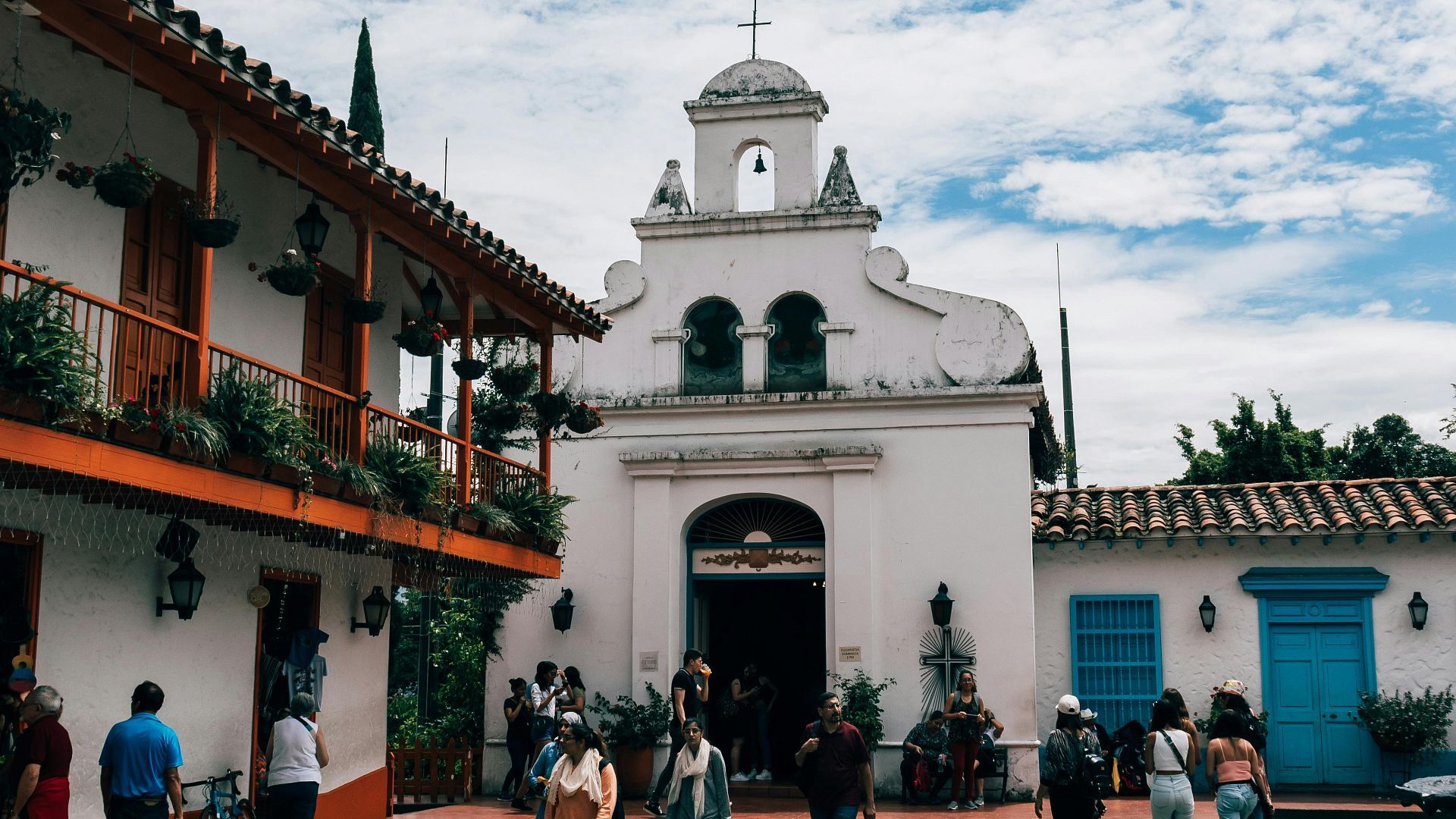
Medellín is a metropolis of brick and glass, innovative and fast-paced. But at its geographic center, elevated 80 meters above the city, time seems to have stopped in the year 1900. Pueblito Paisa is not only the most famous tourist attraction in the capital of Antioquia; it is also a symbol of local identity.
For travelers, climbing Cerro Nutibara (one of the city’s seven iconic hills) is the official “baptism” into Medellín. It is the place where you understand the scale of the valley, where you try your first oblea with arequipe, and where you take the photo you will send to your family to say, “I made it.”
Although some locals consider it “too touristy,” the truth is that its charm is undeniable. And after the recent renovations that improved the public spaces, it is worth rediscovering. Here’s how to enjoy the complete experience beyond the typical selfie.
A Replica with Soul: Architecture of Antioquian Colonization
Opened in 1978, Pueblito Paisa recreates the main square of a traditional Antioquian town. It is not a real town where people live, but rather a living stage set built with materials recovered from old houses demolished across the region (including structures from the town of El Peñol, which was submerged after the construction of the reservoir).
As you walk through its cobblestone square, pay attention to the architectural details that define “Antioquian identity”:
The Central Plaza: Like every Catholic and Spanish-influenced town, life revolves around the square, with its stone fountain and the statue of an important historical figure (in this case, Chief Nutibara).
The Church: It dominates the upper side of the square. Although small, its altar and confessionals are authentic colonial-era pieces.
The Town Hall and School: They represent civil and educational authority. Step inside to see antique wooden desks and maps of old Colombia.
The Color Palette: The facades are painted white (lime-based paint to repel heat), while doors, windows, and balconies (“chambranas”) are painted in vibrant red, green, blue, and yellow tones. This aesthetic is the visual signature of Colombia’s coffee region.
The 360° View: Understanding the Aburrá Valley
What makes Cerro Nutibara unique is its isolated location in the middle of the valley floor. Unlike hillside viewpoints such as Las Palmas, which offer side perspectives, here you are standing at the center of the stage.
From the main viewpoint (recently expanded), you can turn in a full circle and observe all four cardinal directions:
North: Toward the municipalities of Bello and Copacabana, following the river’s path.
South: Toward Envigado and Sabaneta, the area with the greatest urban expansion.
East: Where the towers of El Poblado rise and the Las Palmas road climbs the mountains.
West: Laureles neighborhood, Atanasio Girardot Stadium, and the mountains hiding the tunnel to the Caribbean coast.
The Magical Moment
Try to arrive around 5:00 p.m. You will see the city in daylight, enjoy the sunset (which often paints the clouds orange and violet), and witness the city lights turning on around 6:30 p.m. It is a free spectacle.
Gastronomy: The Flavor of the Mountains
You cannot leave Pueblito Paisa without eating. The food here is traditional, hearty, and comforting.
Bandeja Paisa: Restaurants with balconies overlooking the city serve the full version of this monumental dish (beans, pork belly, beef, egg, chorizo, and more). It is ideal for sharing.
Oblea: The ultimate Colombian street dessert. Two giant thin wafers filled with arequipe (dulce de leche), shredded cheese, blackberry jam, and cream. A sweet and delicious mess.
Mondongo and Sancocho: Thick, flavorful soups, perfect for cloudy or cooler afternoons.
The Hidden Side of the Hill: Art and Nature
Most tourists go up, see the square, and leave. But the hill hides more secrets:
City Museum: Located just below the main viewpoint platform, this museum often features photographic exhibitions about Medellín’s urban evolution. Seeing photos of the city from 50 years ago compared to today’s skyline is impressive.
Sculpture Park: On the hillside, there is an open-air park with abstract modernist sculptures from the 1980s. It is a peaceful trail if you want to walk back down.
Hiking: If you enjoy exercise, you can climb the hill walking or jogging from the base entrance on Calle 30B. It is a paved, safe route frequently used by local athletes.
How to Get There
Location: Calle 30A #55-64.
By Taxi/Uber: The most comfortable option. Ask the driver to drop you off at the summit (there is a public parking lot, although it fills up quickly on weekends).
Turibús: Medellín’s official tourist bus includes a mandatory stop here.
Walking: You can take the Metro to Industriales Station, walk to the base of the hill, and climb through the pedestrian paths (approximately 20–25 minutes uphill). Do this only during daylight hours.
Safety and Tips
Pueblito Paisa is very safe, with constant police presence.
Weekends (especially Sundays) become extremely crowded with local families. If you want clean photos without crowds, visit on a Tuesday or Wednesday morning.
Bring a light jacket; the summit can be windy and cooler in the evening.
From Paisa Tradition to “Sloh” Comfort
Pueblito Paisa represents traditional Antioquian hospitality: open doors, hot coffee, and long conversations on the balcony. Those values are the foundation of the local culture.
When you return to Hotel Sloh in Manila neighborhood, you will find a modern reinterpretation of that same hospitality. We replace colonial architecture with contemporary design and hammocks with smart beds, but the spirit of making you feel at home remains exactly the same.
After seeing the city from above, we invite you to experience it from within, in the comfort of our facilities designed for global travelers who value both tradition and innovation.
Book your stay with a city view at Hotel Sloh.